Florida Assisted Living Licensing and Regulations Explained
A clear guide to Florida license types, dementia training requirements, public oversight and practical questions for families comparing care in Brooksville.
Florida assisted living regulations become easier to use once a family knows which license it is looking at. In Brooksville, a large assisted living facility and a small adult family-care home can appear in the same search, yet they are licensed under different parts of state law. That difference shapes the questions worth asking on a tour. It does not, by itself, show whether a residence is attentive, suitable or well run. Those judgments require a closer look at licensing, daily support, communication and cost.
The Hacienda House is on Powell Road in Brooksville, in Hernando County north of Tampa. Its own site lists a Florida Adult Family-Care Home with 4 beds, offering assisted living style support, memory care support and respite stays. This local example helps show why families should distinguish a license category from a judgment about quality or personal fit.
Florida assisted living regulations start with the license
Florida's Agency for Health Care Administration, usually called AHCA, licenses assisted living facilities under Part I of Chapter 429, Florida Statutes. The associated rules are in Chapter 59A-36, Florida Administrative Code. According to AHCA's assisted living guidance, Adult Family-Care Homes are a separate, smaller license type under Part II of Chapter 429. An AFCH is a private home where the licensee lives and cares for up to five residents. These are legal categories, not ratings or guarantees of personal attention.
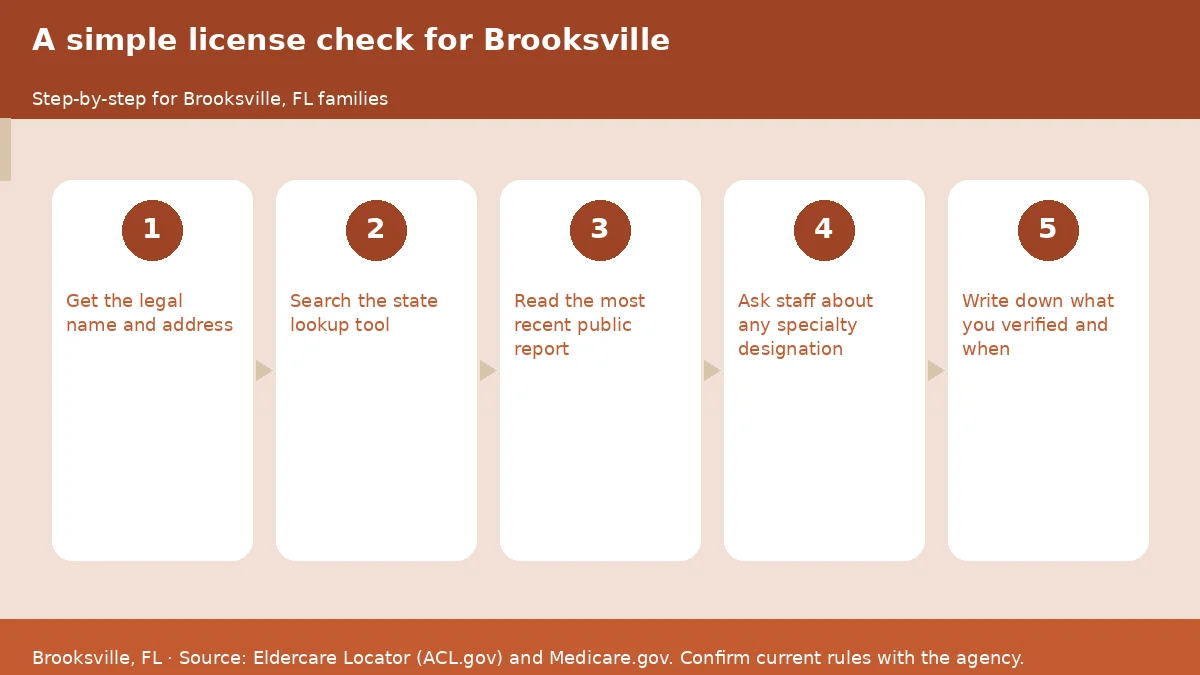
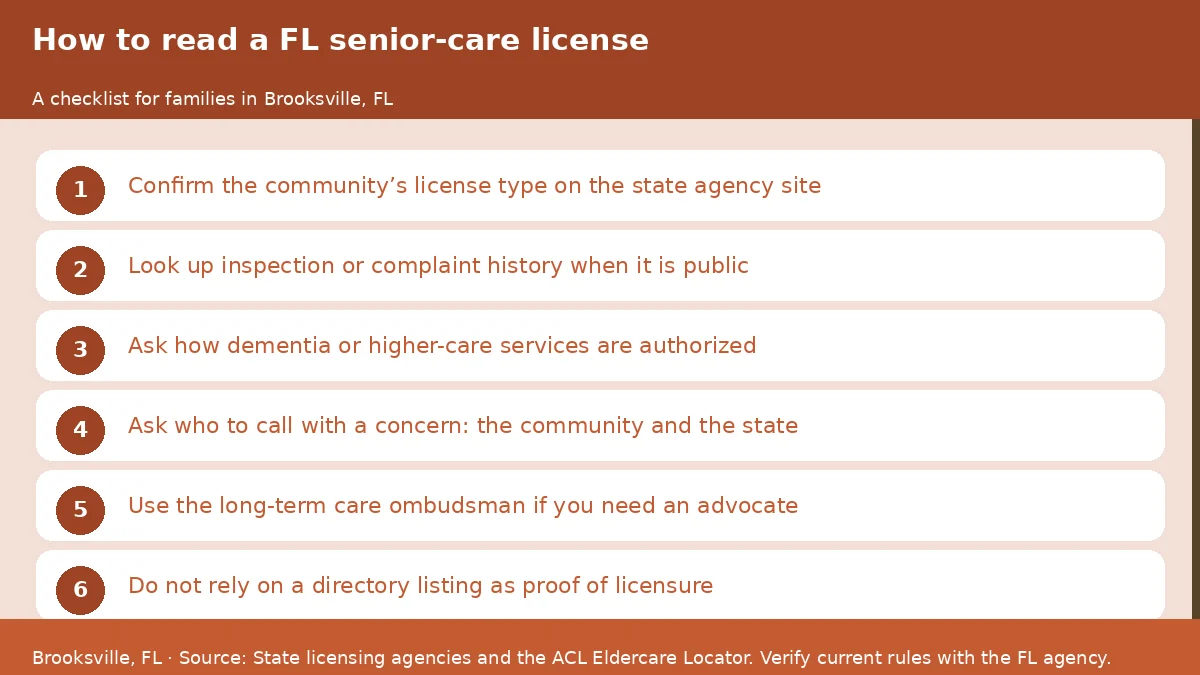
Ask for the exact license type and the name under which a residence is licensed, then confirm that information with AHCA. Do not rely solely on a directory label or on the phrase assisted living in marketing. The Hacienda House should be discussed as a small AFCH, not as a large assisted living facility. Its scale may shape the feel of the household, but families still need clear answers about routines, supervision and how changing needs are handled.
License types and specialty names to ask about
AHCA lists three specialty licenses for assisted living facilities: Extended Congregate Care, Limited Nursing Services and Limited Mental Health, often shortened to ECC, LNS and LMH. Those names are not interchangeable, and their presence should not be inferred from a marketing description. Ask whether a residence holds a specialty license, which one appears on current documentation and what it means for the person being considered. For an AFCH, keep the separate Part II category clear rather than trying to force it into an assisted living facility specialty label.
A license does not answer every practical question. Ask what help is available with bathing, dressing, meals, mobility and daily routines, and which needs would require a different setting. Families comparing assisted living at The Hacienda House with other options can use the same list at each visit. Consistent questions make a small home, a larger campus and a short respite stay easier to compare without assuming that bigger means better or that a specialty name guarantees a fit.
How memory care fits into Florida oversight
Florida requires Alzheimer's/dementia training for staff in facilities that advertise memory care, under s. 429.178, Florida Statutes, according to AHCA. This gives families a specific subject to raise, but the requirement is not a description of any one home's program. Ask which staff receive training, how the residence describes its memory care support and how information about a person's routines is shared with the people providing care.
Memory care should be discussed as support, supervision and environment, never as a way to stop or reverse dementia. In a small residence, ask about the physical layout, daily rhythms, supervision during ordinary activities and the response when needs change. The Hacienda House offers memory care support. Its memory care information can start a conversation, but direct answers about the individual's needs remain essential.
Inspection records and channels for concerns
A state licensing page is not the same as a residence-specific inspection record. AHCA is the starting point for confirming licensing and asking which public inspection or oversight records apply to that license type. The state overview does not establish an inspection schedule or a particular home's compliance history, so families should not fill those gaps with assumptions. Request current documentation and ask how to review available records for the exact licensed name and Brooksville address.
Complaint channels should also be clarified before they are needed. Ask AHCA how concerns about a Brooksville residence can be submitted and what information should accompany them. During a visit, ask who receives concerns inside the home, how families are updated and how a disagreement is documented. Keep a factual record of questions and responses. The Eldercare Locator, a service of the U.S. Administration for Community Living, can connect families with local Area Agencies on Aging for general aging-service guidance. That connection is distinct from filing a licensing complaint.
A Brooksville tour checklist
Use the tour to test whether the legal category and the lived environment fit your relative's needs. A Brooksville visit can be unhurried and specific:
- License: Match the license type and licensed name to AHCA information, and ask about any specialty license that is claimed.
- Daily support: Discuss help with personal care, meals, mobility and routines without assuming that every service is included.
- Memory support: If relevant, ask about dementia training, supervision and the environment rather than promises of improvement.
- Changes in need: Ask what happens if support needs increase and when another setting would be considered.
- Communication: Identify the person who answers family questions and ask how updates and concerns are handled.
- Respite: For a short stay, discuss what information must be transferred and how routines will be kept consistent.
- Cost: Request current rates and a written explanation of what is included, without treating a regional median as a quote.
The National Institute on Aging explains that respite care can be provided at home, in adult day centers or through short residential stays, giving family caregivers a temporary break. For relatives traveling from Spring Hill, Weeki Wachee or elsewhere in Hernando County, also consider the drive, visiting routine and access via the Suncoast Parkway. Practical familiarity matters alongside paperwork.
Put costs beside the license, not ahead of it
A median is a market reference, not a residence's price, and different types of care are not interchangeable.
Cost should be considered with required support rather than used as a shortcut for quality. These figures are not rates for The Hacienda House. Families should call the home for current rates and ask exactly what is included, how respite is billed and which changes could affect the monthly charge.
Payment sources need the same careful verification
Medicare has a clear limit: Medicare does not cover long-term custodial care when that is the only care needed, and Medicare notes that most long-term care is custodial. Do not assume that a short-term medical benefit will pay for ongoing residential support. Long-term care insurance is different. The Administration for Community Living explains that policies may cover assisted living depending on their terms, often after an elimination period and when the policyholder needs help with activities of daily living or has cognitive impairment. Read the actual policy.
Wartime-era Veterans and surviving spouses may want to review VA Aid and Attendance, an increased monthly amount added to a VA pension for people meeting care and other eligibility requirements. The current VA pension rate guidance explains that pension equals the maximum annual rate minus countable income and describes net worth and asset-transfer review. A maximum rate is not an automatic monthly payment. Florida's Statewide Medicaid Managed Care Long-Term Care program can cover services including assisted living services, personal care, adult day care and respite for Medicaid-eligible people who need nursing facility level of care. Enrollment is limited and there is a waitlist; screening begins through the local Aging and Disability Resource Center.
Bring the evidence together
A sound Brooksville comparison can be organized on one page: exact license category, AHCA confirmation, available public records, dementia-training questions where relevant, daily support, communication, respite arrangements and current written rates. Add notes about whether the environment feels manageable for the individual and whether answers are consistent. Do not let a specialty name, a small household or a regional cost median stand in for that review.
Florida assisted living regulations are most useful when they lead to better questions rather than quick conclusions. For one family, an AFCH may warrant close consideration because of its residential scale; for another, the deciding issue may be supervision or a future change in needs. The goal is a documented, realistic fit between the person, the residence and the family's ability to sustain the arrangement.
Frequently asked questions
Who licenses assisted living and adult family-care homes in Brooksville?
Florida's Agency for Health Care Administration (AHCA) licenses assisted living facilities under Part I of Chapter 429, Florida Statutes, with rules in Chapter 59A-36, Florida Administrative Code. Adult Family-Care Homes are a separate, smaller license type under Part II. A Brooksville family should ask for the residence's exact licensed name and category, then confirm that information with AHCA rather than relying on a directory description.
Is The Hacienda House a large assisted living facility?
No. The Hacienda House's own site lists it as a Florida Adult Family-Care Home with 4 beds on Powell Road in Brooksville. It offers assisted living style support, memory care support and respite stays in a small residential setting. That category does not by itself establish quality or suitability. Families should still ask about daily support, supervision, communication, changing needs and current rates during their review.
What Florida rule applies when a residence advertises memory care?
AHCA states that Florida requires Alzheimer's/dementia training for staff in facilities that advertise memory care, under s. 429.178, Florida Statutes. Brooksville families can ask which staff receive training and how memory care support is provided day to day. The conversation should focus on supervision, environment and individual routines, not on claims that memory care will stop or reverse dementia.
How can a family check inspections or raise a concern?
Start with AHCA and the residence's exact licensed name and Brooksville address. Ask which public licensing and inspection records apply to that license type, and how a concern can be submitted. A general state licensing webpage is not a residence-specific inspection report. During a tour, also ask who handles family concerns internally, how responses are documented and how relatives receive updates.
Does Medicare pay for ongoing assisted living in Brooksville?
Medicare states that it does not cover long-term custodial care if that is the only care needed, and most long-term care is custodial. A Brooksville family should not assume Medicare will pay for ongoing residential support. Review any long-term care insurance policy directly, and ask the residence for current rates and a written explanation of included services. Veterans and Medicaid-related options have separate eligibility rules.
Talk with The Hacienda House
If you are weighing care options in Brooksville, call (352) 652-8436 or schedule a tour. Our team can talk through current availability, rates and next steps. Please confirm all details directly, since published figures and listings change over time.
Sources
- VA Aid and Attendance and Housebound benefits
- VA pension rates (current)
- Medicare: long-term care coverage
- Eldercare Locator (U.S. Administration for Community Living)
- National Institute on Aging: What is respite care?
- ACL: What is long-term care insurance
- Florida AHCA: Assisted Living Unit
- Florida AHCA: Statewide Medicaid Managed Care Long-Term Care Program
Program rules and benefit amounts were checked on the linked official pages in November 2026 and can change.
Related reading on this site: