Signs It's Time for Assisted Living: A Guide for Brooksville Families
A practical guide to changes at home, caregiver strain, respectful conversations, respite stays and local care costs for Brooksville families.
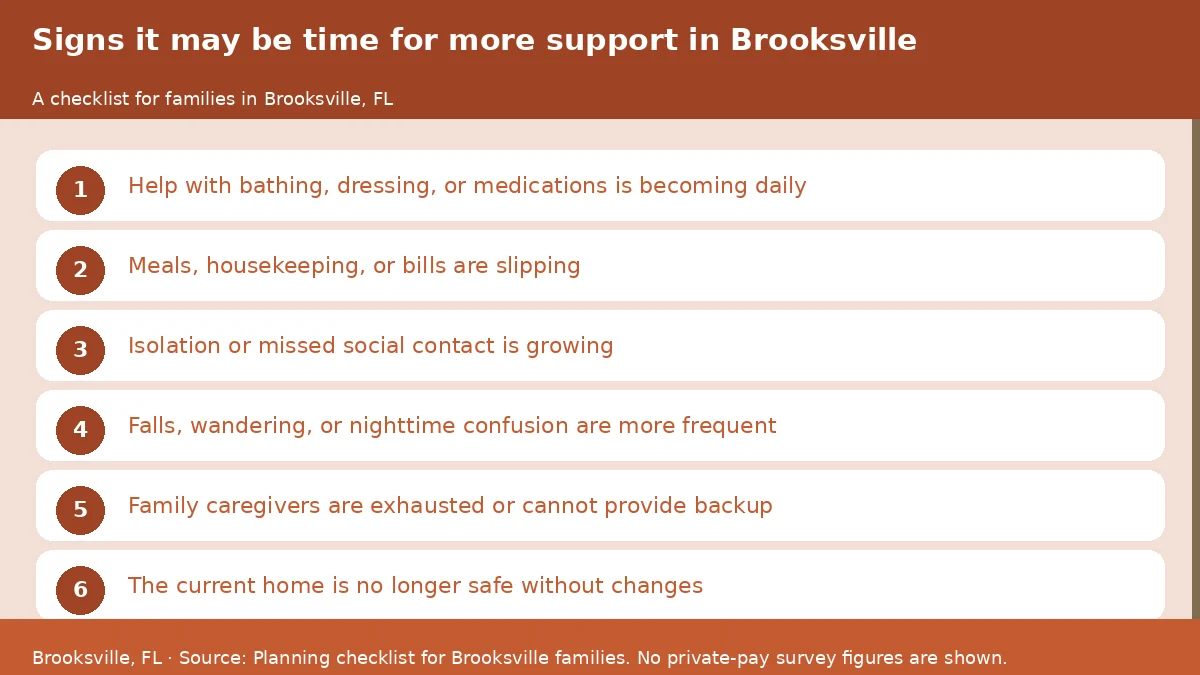
Looking for the signs it's time for assisted living in Brooksville usually begins with small changes: a parent stops cooking, a spouse is sleeping badly, or pills remain in the organizer. No single event settles the question. A pattern across daily routines, safety and caregiver capacity is more useful than waiting for one dramatic incident.
Assisted living can add help with everyday tasks, meals and supervision, but the right decision also depends on personality, finances and the kind of setting a person will accept. For some Brooksville families, a small residential home is part of that comparison, alongside care at home and adult day services.
Signs It's Time for Assisted Living: A Brooksville Checklist
Start with what has changed, not with a label. An older adult may hold onto furniture while walking, have trouble rising from a chair, avoid the shower, or wear the same clothes because dressing and laundry have become difficult. Meals may shrink to snacks, or food may be prepared but left uneaten. These observations do not explain why something is happening. They show where a closer look and a conversation with the appropriate professional may be useful.
Medication routines deserve the same specific attention. Look for a pillbox that remains full, tablets found in unusual places, duplicate refills, uncertainty about instructions, or reliance on a spouse to remember every dose. Do not stop or rearrange medication based on a home observation. Record what you see and ask the prescriber or pharmacist about the routine. Repeated mistakes matter because a reminder system that once worked may no longer be dependable.
Household, safety and social changes
A home often reflects declining capacity before someone describes a problem. During an ordinary visit, notice whether basic tasks are being completed and whether familiar routines have become risky. Useful observations include:
- Spoiled food, empty cupboards, unopened mail or accumulating laundry.
- Burned cookware, an appliance left on, or doors routinely left unsecured.
- New difficulty managing steps, bathing, toileting or getting around at night.
- Getting lost on a familiar route, unexplained vehicle damage, or confusion about a routine errand.
- Frequent calls for help with tasks that were previously managed independently.
Withdrawal can be easier to miss. A parent may stop attending church, visiting friends or going to a favorite Brooksville activity because transportation, hearing, mobility or confidence has changed. Long stretches alone can also leave a spouse as the only regular visitor. A residential setting may provide meals and opportunities for company, but it does not guarantee friendships. Ask whether the person would actually use the shared spaces and activities, and how much privacy remains available.
When caregiver strain becomes part of the decision
Caregiver exhaustion is relevant information, not a failure of devotion. A spouse may be lifting, interrupting sleep, managing every appointment and checking the house repeatedly. An adult child may leave work often, postpone personal appointments, or feel constantly alert for the next phone call. Resentment followed by guilt can make the situation harder to discuss, but both feelings are common signals that the present arrangement needs review.
Write down which tasks the caregiver performs and which ones require another person to step in. Then consider what would happen if that caregiver became ill or needed to travel. If one absence would leave nobody to prepare meals, supervise medication or respond at night, the plan is fragile. Additional home help may resolve some gaps; a residential setting may address others. The safer comparison is between complete plans, not between an idealized home routine and a facility.
Starting the conversation without taking over
Choose a calm time rather than raising a move immediately after a fall, argument or medication mistake. Begin with observations and concern, then ask what your parent has noticed and what matters most. Privacy, pets, familiar belongings, cost and fear of losing control may be central. Listening does not require agreeing that everything is fine. It means understanding which parts of a change feel acceptable and which feel threatening.
Keep the language concrete. Instead of announcing that someone cannot live alone, explain that showering has become unsafe, meals are being skipped, or nighttime supervision is beyond what the family can provide. Invite your parent to visit settings, review options and identify questions. Avoid presenting a tour as a trick or a completed decision. If there is immediate danger or serious uncertainty about decision-making, involve the appropriate professionals rather than expecting one family meeting to resolve everything.
Using a respite stay as a practical trial
The National Institute on Aging explains respite care as a short-term break for family caregivers, provided at home, through adult day centers or during short residential stays. A short stay can give a Brooksville family direct information about routines, personal preferences and the amount of support a parent requests. It should be approached as a trial and a caregiving break, not as a promise that someone will settle in or that a permanent move will follow.
Before booking, ask how meals, medication routines, laundry, nighttime supervision and family updates are handled. Clarify the length of the stay, what to pack, the cancellation terms and every charge in writing. Afterward, discuss what felt comfortable and what did not. Respite stays at The Hacienda House can be considered as one local option, with the same careful questions applied as anywhere else.
What Brooksville-area care costs mean for planning
Cost comparisons need a consistent geography. places Brooksville and Hernando County in its Tampa Area region, with data collected from July through November 2025.
Monthly comparisons depend on the schedule and setting:
The 20-hour home care estimate is not a substitute for full-time supervision, and assisted living is not interchangeable with nursing home care. Ask every provider what the quote includes, how changing care needs affect the bill, and which services cost extra. These area figures are not The Hacienda House's rates; call the home for current rates.
Paying for care and finding local guidance
Do not build a plan around assumed Medicare coverage. Medicare states that it does not cover long-term custodial care when that is the only care needed, and most long-term care is custodial. Long-term care insurance is separate: federal guidance on long-term care insurance advises reading the policy for covered services, elimination periods and benefit triggers, which may involve daily activities or cognitive impairment.
Aid and Attendance can increase a VA pension for eligible wartime-era Veterans or surviving spouses who need help with daily activities or meet other criteria. The VA's current pension rates list maximum annual pension rates with Aid and Attendance of $29,093 for a Veteran with no dependents and $34,488 for a Veteran with one dependent. From December 1, 2025 through November 30, 2026, the net worth limit is $163,699. These are not automatic care payments. The pension calculation subtracts countable income, and some unreimbursed care expenses can affect it. Eligibility and asset-transfer rules deserve individual guidance.
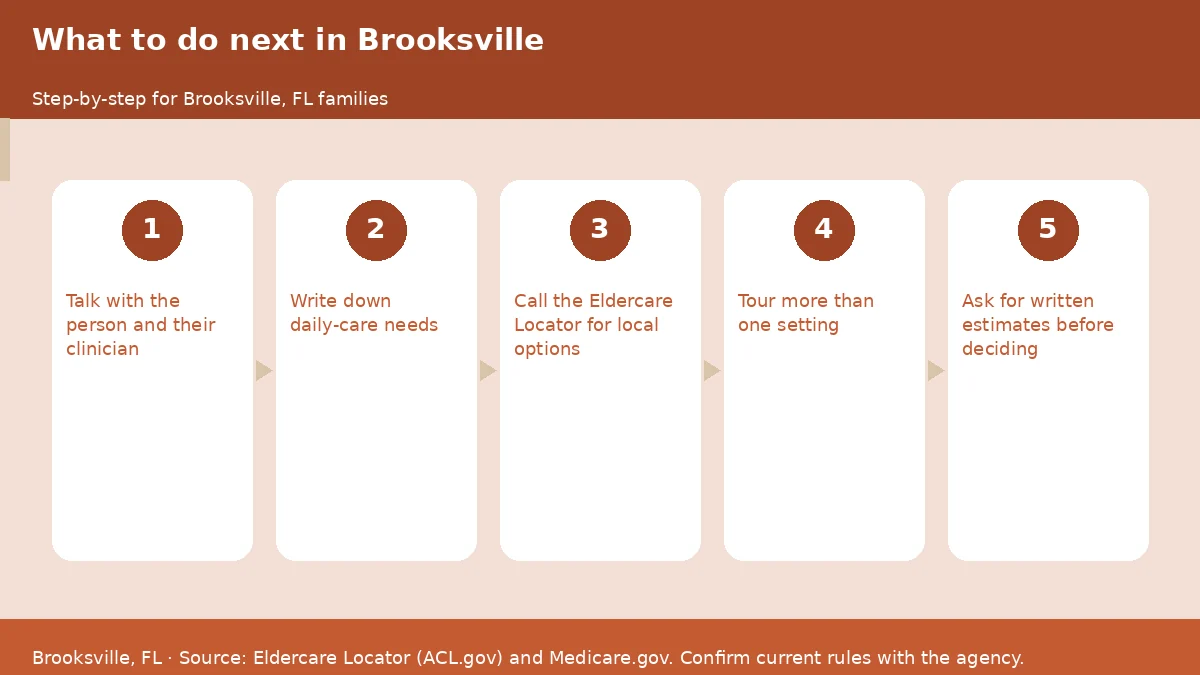
Florida's Statewide Medicaid Managed Care Long-Term Care program can cover services including assisted living services, personal care, adult day care and respite for people who meet medical and financial requirements. Enrollment is limited and there is a waitlist; screening begins through the local Aging and Disability Resource Center. The Eldercare Locator can also help families find their local Area Agency on Aging. Ask each provider directly which payment sources it accepts.
Questions to bring to a small Brooksville home
Florida distinguishes small adult family-care homes from larger assisted living facilities. The Florida Agency for Health Care Administration's licensing guidance places AFCHs under Part II of Chapter 429, Florida Statutes. The Hacienda House is an AFCH on Powell Road in Brooksville, with 4 beds listed on its own site. It offers assisted living style support, memory care support and respite stays in a small residential setting.
For a parent with dementia, ask what memory care support means in everyday practice: supervision, cues, a manageable environment, secure routines and communication with family. It should not be presented as a treatment or a promise to change dementia. Florida also requires dementia-related staff training in settings that advertise memory care, so families can ask how training applies to the people providing care.
Bring the same written questions to every tour. Ask who is present during the day and overnight, how personal care and medication routines are handled, how changing needs are communicated, and which services affect the monthly rate. Notice whether residents can make ordinary choices and bring familiar belongings. For families in Spring Hill, Weeki Wachee and elsewhere in Hernando County, consider the drive for regular visits as well as the first tour. A clear answer about routines and limitations is more useful than a polished presentation.
Frequently asked questions
What are the clearest signs a Brooksville parent may need assisted living?
The clearest sign is a repeatable pattern rather than one bad day. In Brooksville, look for missed meals, unsafe bathing, medication mistakes, increasing falls or near-falls, a neglected home, getting lost, isolation, or a spouse who can no longer provide care safely. Write down examples and discuss them with your parent and the appropriate professionals. An urgent safety problem needs prompt attention; do not wait for a routine tour.
Does a Brooksville respite stay commit a parent to moving permanently?
No. A respite stay is a short-term arrangement, not an automatic commitment to a permanent move. It can show how your parent manages meals, personal routines, unfamiliar surroundings and staff support, while giving the regular caregiver a break. Before booking in Brooksville, ask what the stay includes, how medications and laundry are handled, what supervision is available at night, and how the home will communicate with family.
How much does assisted living cost near Brooksville?
These figures are planning benchmarks, not The Hacienda House's rates. Call the home for current rates and a written list of included services and possible extra charges.
Does Medicare pay for assisted living in Brooksville?
Medicare generally does not pay for long-term custodial care when that is the only care needed, and most long-term care is custodial. Families should not assume Medicare will cover an ongoing assisted living stay in Brooksville. Separate coverage questions can arise for specific medical services, so review the person's situation with Medicare and the care providers. Veterans benefits, long-term care insurance and Florida Medicaid programs have their own eligibility rules.
How is a Florida adult family-care home different from assisted living?
Florida treats an adult family-care home as a separate, smaller license type under Part II of Chapter 429, Florida Statutes, rather than licensing it as a large assisted living facility under Part I. The Hacienda House's site describes it as a 4-bed AFCH. Families can ask the home for its license information and inspection history and can contact Florida's Agency for Health Care Administration to understand the applicable records and requirements.
Talk with The Hacienda House
If you are weighing care options in Brooksville, call (352) 652-8436 or schedule a tour. Our team can talk through current availability, rates and next steps. Please confirm all details directly, since published figures and listings change over time.
Sources
- VA pension rates (current)
- Medicare: long-term care coverage
- Eldercare Locator (U.S. Administration for Community Living)
- National Institute on Aging: What is respite care?
- ACL: What is long-term care insurance
- Florida AHCA: Assisted Living Unit
- Florida AHCA: Statewide Medicaid Managed Care Long-Term Care Program
Program rules and benefit amounts were checked on the linked official pages in November 2026 and can change.
Related reading on this site: